
Interlacements (Biel)Sur-impressions, Pasquart Centre d’Art
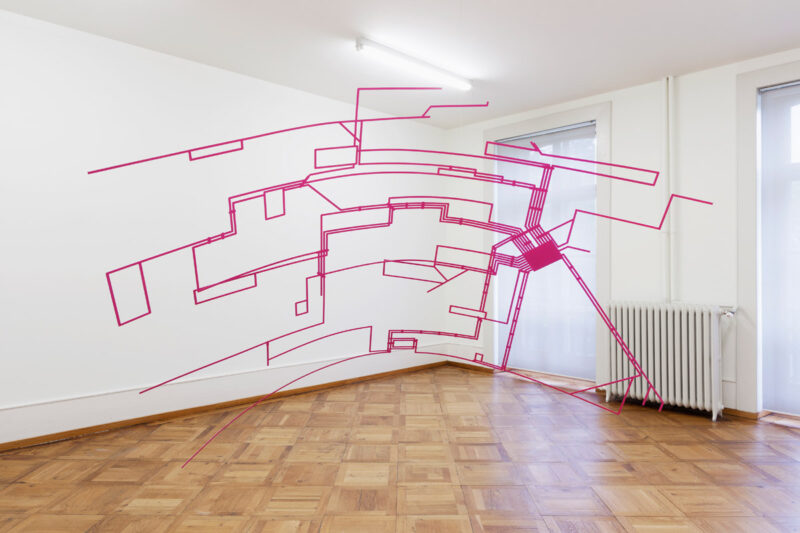
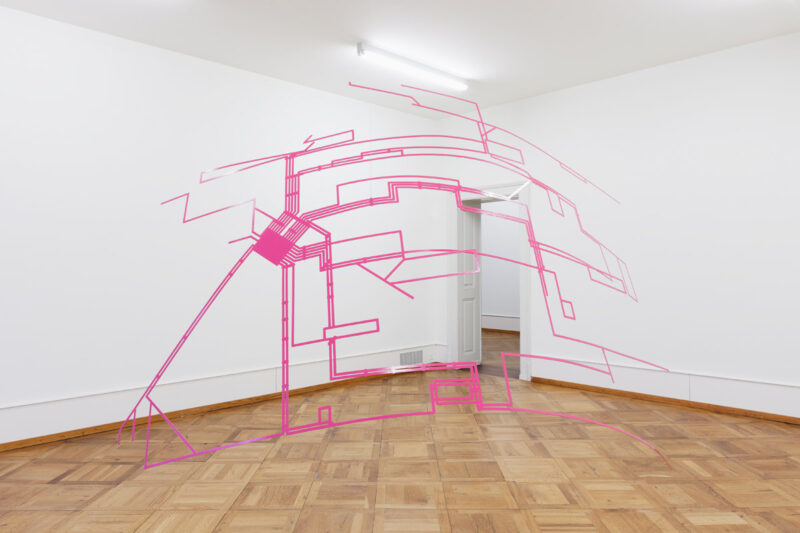
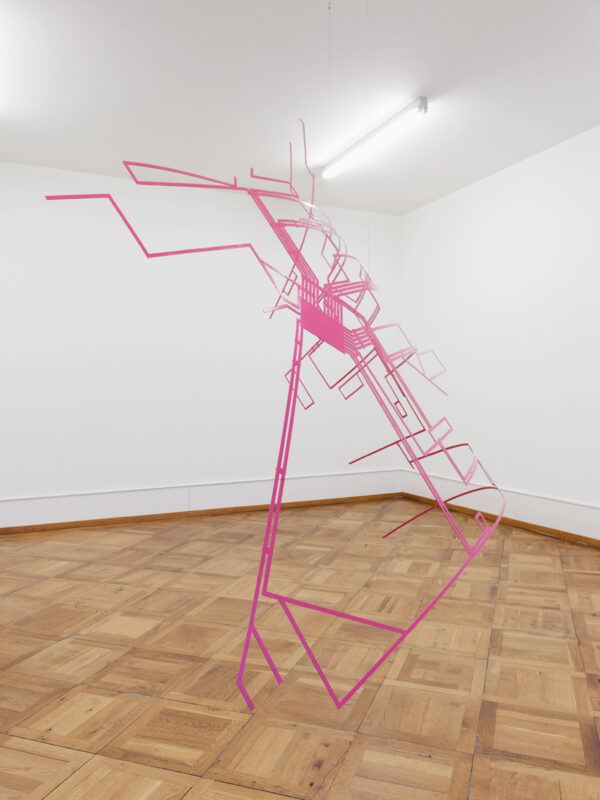
Interlacements (Biel)
Steel, paint
340 x 340 x 220 cm
https://kbcb.ch/de/ausstellungen/pascal-haeusermann
Pascal Häusermann (*1973, Chur) takes up and reinterprets traditional patterns, forms or representations. Surprising combinations with intelligent references to social, economic or cultural phenomena are created as a result. The artisanal – demonstrated, for example, in the connections with stone masonry, engraving and typography techniques and, as a recent addition, the patterns of mosaic tiles – plays an important role in the artist’s work.In his first institutional solo exhibition Pascal Häusermann focuses on the principle of layering which is ground-breaking for his practice. This form of superimposition plays with the ambiguity between duality and unity. What first appears as a unit reveals itself to be pieced together but can then be synthesised again. The artist is interested not only in the layers of various media, such as photography and woodcut, but also in the superimposition of or connection between historical and current sources of imagery, or of different thematic links. In the first part of the exhibition (> first room on the right) Häusermann is showing a series of monotypes (Salvation) which he has been adding to continuously since 2010. For each one a motif taken from nature from a 15th century woodcut is laid over a contemporary „high-end“ interior. Not only are two quite different media – woodcut and photography – combined, but also two worlds. Even if the layered images appear very different at first, they have one thing in common: they emphasise the grandeur of that which is represented. This can be the dramatic staging of nature just as much as the elegant new building dominated by steel and glass. What occurs in Salvation on a two-dimensional plane is transferred onto the three-dimensional with the installation made especially for the spaces of the CentrePasquArt. A gigantic bough with intertwining branches grows from out of the wall, takes over the corridor of the museum and ends finally in one of the exhibition rooms. The sculpture is complemented by a wallpaper recalling plant forms. By combining different subjects or media, Häusermann draws attention to contrasts or similarities on the one hand and, on the other, he’s also concerned to break rigid systems of imposing order. The system of straight lines and perfect geometric forms of contemporary buildings are thus ruptured by plants running riot or the system of obstinately repeated mosaics by the endless network of streets in Paris. Repetitive forms, clearly defined patterns or abstract plans are also taken up, minutely examined and finally undermined by Häusermann. For the 18 part series of lithographs Sur-impressions (2014,> second room from right) the artist has pitted four different systems against each other: mosaics, the public transport system in Biel, an architectural motif and a natural element. Each one appears, asserts itself towards the others and finally disappears again. The themes that Pascal Häusermann tackles in sur-impressions become increasingly significant as the exhibition continues. Works are presented that were produced in the context of a residency in Paris. In connection with the intense intercultural exchange between France and Islamic countries, Häusermann concentrated on the tradition of Moroccan and Moorish influences on art. He set himself the goal, for example, of taking mosaics, the patterns of wall paintings and ornamental reliefs on facades as a starting point for forming the flat motifs into three-dimensional structures. In Octagonal Extension (2013,> third room from the right), for example, the artist has playfully used lines from a mosaic to create a sculpture whose three-dimensionality is immediately negated by its own shadow. In other works the tracery of the mosaic acts as a symbol for the (urban) labyrinth which Walter Benjamin discusses in Passagen-Werk: „The city is the realisation of the old dream that humans have of the labyrinth. Without knowing it, the flaneur pursues this reality. » Inspired by Benjamin’s thought, Häusermann creates links between the mosaics and city plans or the Paris metro system and thus connects the geometric patterns with an orientation system. On the other hand, the combination of religious and urban orna-mental forms evokes numerous associations with the social and cultural life of Paris. A work that was created in this context and is presented in the exhibition is Walking through Paris along a Mosaic (2013/2014, > fourth room from the right). For this video Pascal Häusermann laid the mosaic that he used for Octagonal Expansion over the map of Paris, connecting the superimposed areas. The path that was produced by the layering of the two systems provided the route for the walk, on which the artist is accompanied by the camera. What appears at first to be the aimless wandering of a flaneur is in reality merely the following of a prescribed path. The exhibition is completed by Interlacements (Biel) (2014), a three-dimensional version of the public transport plan of the town of Biel. Like a disproportionately large paper cut-out made of metal, suspended in the room, this plan – the system created to help orientation – appears much more chaotic than the urban reality it was intended to simplify. It quickly becomes clear that the Biel transport network isno less complex than the Paris metro and bus system. It is left to the viewer to consider in what ways these two cities are otherwise similar.
Irène Zdoroveac